A Dark Stories original
The woman outside Justin’s apartment had been knocking for eleven minutes when he recognized her voice.
“Justin. Please open the door.”
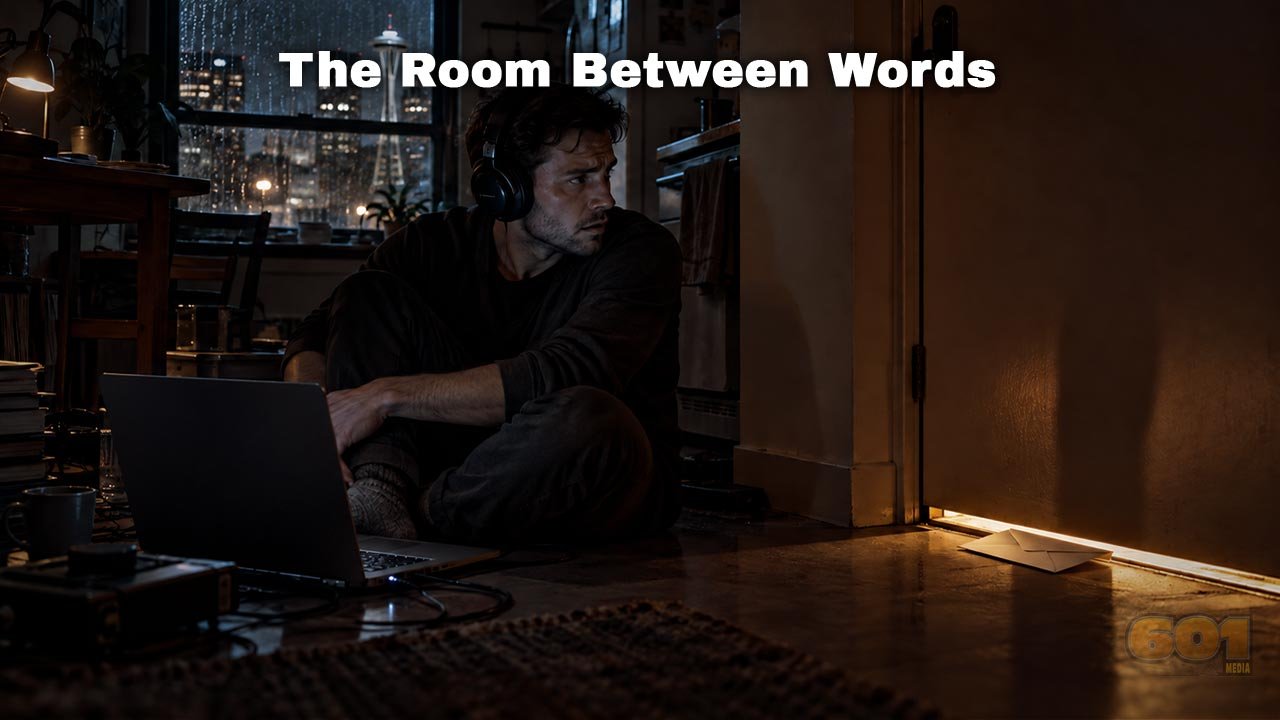
He sat on the kitchen floor with his headphones clamped over his ears. On his laptop, the same sentence waited beneath a thin white cursor.
He played it again.
“Justin. Please open the door.”
Same breath. Same tremor. Even the small click of her tongue before his name.
The recording was nineteen years old.
Outside, the woman stopped knocking.
“I know you found me.”
Three days earlier, Justin Vale had been worried about rent.
At thirty-four, he repaired damaged recordings for people who usually expected miracles at clerical rates. Wedding speeches. Court interviews. The last voicemail from somebody’s father. He worked in a narrow apartment above a shuttered alterations shop in Seattle, where the rainwater backed up against his window frames.
His sister Leah called it a depressing way to make a living.
“You spend all day listening to dead people.”
“Mostly lawyers.”
She laughed. He liked making her laugh. Since their mother’s death, it had become one of the few things he could reliably do for her.
The contract arrived through Owen Mercer, a former colleague who now managed records for a property company. Eight hundred dollars to recover audio from an old drive found during a building clearance in SODO.
“Training interviews,” Owen said. “Probably nothing usable. They just need someone to check before disposal.”
The drive came by courier in a padded envelope. Owen had included a note: Invoice me directly.
Most folders contained expense sheets and recordings of empty conference rooms. Justin nearly declared the job finished before noticing a hidden directory that the recovery software had restored without a name.
Inside was one audio file.
Forty-three minutes. Dated November 2007.
For the first minute, there was ventilation noise and the movement of a chair. Then a man said, “Describe the room again.”
A woman answered.
“Yellow curtains. A crack above the sink. He keeps saying he’ll fix it.”
Justin took off his headphones.
His mother had yellow curtains in their old apartment. There had been a crack above the sink. His father had promised to repair it until the day he left.
Coincidence, he thought.
He put the headphones back on.
“And your children?” the man asked.
“Justin is fifteen. Leah turned nine in April.”
His mother sounded tired, but he knew her. Beneath the words was the faint whistle she made through a chipped tooth she never had repaired.
“Good,” the man said. “Now we’ll do the doorway.”
Paper rustled.
His mother began to read.
“Justin. Please open the door.”
He called Owen.
“What building did this come from?”
“I’d have to check.”
“My mother’s on it.”
Silence.
Then Owen said, too lightly, “You sure?”
Justin sent him a twenty-second excerpt. He regretted it almost immediately.
That evening, he listened to the rest.
The man asked his mother to describe neighbors, family arguments, the route her children walked to school. Sometimes he corrected her.
“Your husband left in February.”
“March,” she said.
“For this exercise, February.”
She repeated it.
Near the end, she asked when Leah would be allowed to come home.
The man moved something across the table.
“Let’s finish the statements first.”
Justin remembered Leah being away that autumn. His mother had said she was staying with an aunt while their apartment was treated for mold.
He remembered asking why he couldn’t go too.
He couldn’t remember the answer.
At midnight, his email notified him that somebody had requested a password reset. Then his phone briefly lost service.
At 12:14, Owen texted.
Stop working on that drive. Client says it contains medical material.
Justin copied the file onto a memory card and slid it inside an old camera battery case.
For the first time in years, the apartment felt too quiet.
Leah met him the next morning at a café near her work.
She listened with one earbud, her coffee untouched.
“That’s Mom,” she said.
“Do you remember staying with Aunt Rose?”
“A little.”
“What does a little mean?”
She removed the earbud.
“It means I was nine.”
He told her about the questions, the changed dates, the demand to know when she could come home. Leah watched a bus pass outside.
“There was a place,” she said eventually. “Mom called it a sleep clinic.”
Justin waited.
“They put things on my head. Played recordings. I thought everybody did it.”
“Why didn’t you tell me?”
“You were a kid too.”
He reached across the table, but she folded her hands in her lap.
“Don’t turn this into something you can fix by listening harder.”
As she stood, a man at the counter looked down at his phone. He wore a green raincoat with a torn cuff.
Justin had seen that coat outside his building that morning.
He stayed seated until the man left.
Owen finally supplied the address. He also offered another eight hundred dollars to return the drive immediately.
Justin went to the building instead.
It stood behind a chain-link fence, three floors of stained concrete. A demolition notice curled beneath cloudy plastic. Through the entrance glass, he could see a reception counter and a pale rectangle where a company name had been removed.
A maintenance worker let him in when he mentioned Owen.
“Records guy?”
Justin nodded.
“Basement. Whatever’s left.”
Downstairs, the rooms had observation windows covered from the inside. In one, adhesive marks formed a square around the place a chair had stood.
He photographed everything.
A cabinet contained blank consent forms bearing the name Northline Behavioral Research. Behind a drawer lay a carbon copy of a payment receipt.
His mother’s name. Six hundred dollars.
Under purpose: Dependent participation—continuity sessions.
He was still reading when his phone rang.
Owen.
“Come upstairs.”
Owen stood beside the reception counter. He looked older than he had three days earlier.
“I didn’t know it was your family,” he said.
“What was this place?”
“A contractor. Different clients. I handled storage.”
“You sent me the drive.”
Owen rubbed his face.
“They asked who I used for audio recovery. I gave them your name. Then they asked whether I knew you personally.”
Behind him, a door opened.
A woman in a gray coat entered carrying a paper cup. She was perhaps sixty. Ordinary enough that Justin might have passed her in a grocery store without remembering her.
“Mr. Vale. I’m Helen.”
“Who do you work for?”
“Your mother signed confidentiality agreements. So did several people responsible for your sister’s care.”
“She was nine.”
Helen set down the cup.
“Yes.”
The answer was worse than an excuse.
She explained that families had once participated in research involving memory, suggestion, and witness reliability. Her language was careful. Every person became a participant. Every frightening thing became a procedure.
“Some records were retained improperly,” she said. “We’re trying to locate them.”
“Then why send one to me?”
Helen glanced at Owen.
Justin saw it: the question she had hoped he wouldn’t reach.
“You wanted to see what I remembered.”
Owen stared at the floor.
Helen asked for Justin’s phone.
He ran.
Nobody chased him into the street.
That frightened him more than pursuit would have.
At home, his key worked, but the apartment smelled faintly of lemon cleaner. His computer was still on his desk. The drive was gone.
So was a framed photograph of his mother.
He retrieved the memory card with shaking hands.
Leah’s phone went to voicemail. He called her work. She had left early.
He sent her a message: Don’t go home. Call me from somewhere public.
Then he opened the recovered audio and stopped listening to the voices.
For years, clients had paid him to remove room noise. Now he listened beneath the conversation: ventilation, furniture, distant doors.
There were edits.
Not obvious cuts. Whole stretches of silence had been carried across joins to disguise them. But the background hum changed phase, and a chair scrape appeared twice with exactly the same shape.
The file wasn’t one interview.
It was assembled from several sessions.
He isolated a low voice beneath his mother’s final statement. Someone speaking away from the microphone.
“Keep the brother separate. She follows his corrections.”
A younger voice answered.
“Do I tell her about the stairs again?”
Justin pushed back from the desk.
He knew that voice too.
When Leah called, she was crying quietly.
“Why did you send them the recording?”
“I sent it to Owen. I didn’t know.”
“Helen came to my office.”
He pressed the phone against his ear.
“What did she say?”
“That you’re confused. That I shouldn’t encourage you.”
Rain rattled the window.
“Leah. Was I at the clinic?”
She took so long to answer that he thought the connection had failed.
“You told me I fell down the stairs.”
His stomach contracted.
“Did you?”
“I don’t know.”
He remembered a kitchen table. His mother smoking although she had supposedly quit. A woman asking him to help his sister get well.
It arrived without warning, like a scene from somebody else’s childhood.
“They said you were making things up,” he whispered.
“I know what they said.”
“I was fifteen.”
“I know that too.”
He wanted to explain the things a frightened boy might believe if adults repeated them often enough. But Leah had been nine, and he had been the person she trusted.
“Where are you?” he asked.
“Somewhere you don’t know.”
The call ended.
He uploaded the recording and his photographs to a private folder and emailed a local investigative reporter. Then he wrote down everything he could remember before the new memories had time to settle into certainty.
At 9:20, somebody knocked.
“Justin. Please open the door.”
His mother’s voice.
He brought the laptop to the kitchen floor, away from the windows, and compared it with the recording.
The same sentence. The same breath.
After eleven minutes, the voice said, “I know you found me.”
That line wasn’t in the file.
He crawled to the door.
Through the peephole, he saw a woman with his mother’s posture. Her head was lowered. Water dripped from the hem of her coat.
His mother had been cremated six years earlier. He had chosen the urn with Leah.
“Look up,” he said.
The woman remained still.
“What did you call me when I was little?”
“June bug.”
He closed his eyes.
They had recordings. They had interviews. They had enough of her to do this.
“Look up.”
Instead, an envelope slid beneath the door.
Inside was the photograph missing from his apartment.
On the back, in fresh ink, someone had written:
Ask Leah who was at the bottom of the stairs.
When he looked again, the hallway was empty.
The reporter replied the following afternoon. She would meet him, but first she wanted the original drive and someone willing to corroborate his account.
Owen’s number no longer connected.
The building’s maintenance worker said he hadn’t let anybody inside. By the end of the week, the basement was rubble.
Leah sent one message.
I’m safe. Please let that be enough for now.
Justin moved into a motel north of the city. He paid cash and left the television unplugged. At night, he listened to the file through cheap headphones, terrified of missing something and increasingly unable to trust anything he heard.
He stopped restoring clients’ recordings. He couldn’t bear to remove a breath or smooth a pause. Every correction felt like helping somebody lie.
On the ninth night, he found another join.
Beyond it was a faint sound he had mistaken for a chair: three soft taps, a pause, then two.
Their childhood signal through the bedroom wall.
Are you awake?
He turned up the volume.
His younger self spoke, close to the microphone.
“She won’t say it while he’s in here.”
The interviewer asked who he meant.
Justin could hear himself breathing. Then a door opened in the recording, and his mother began to cry.
At the motel, someone tapped on the other side of the wall.
Three times.
A pause.
Twice.
Justin held his breath.
On the recording, the interviewer said, “Don’t answer her.”
From the room next door, Leah whispered his name.