


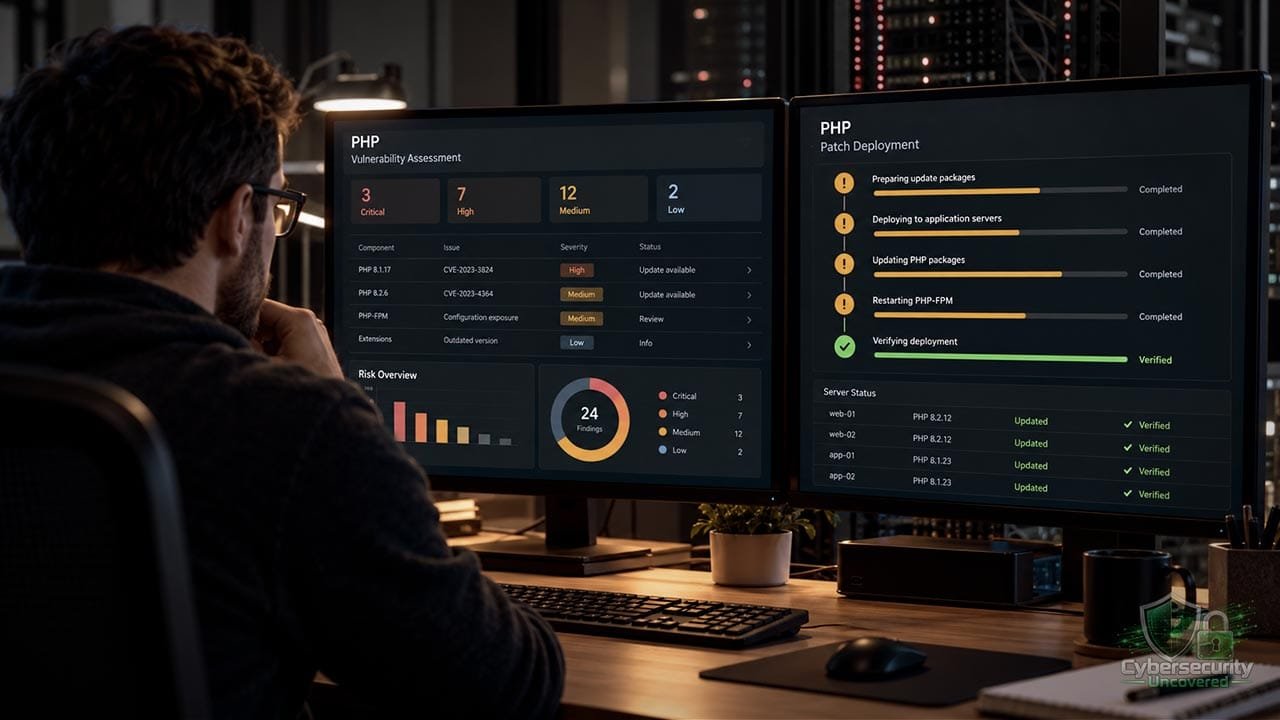
The PHP Security Crisis: OpenAI’s Response and Steve Gibson’s Warning for Defenders
Two critical PHP vulnerabilities have exposed a difficult security problem: finding a dangerous flaw is only the beginning. Drawing on Steve Gibson’s Security Now coverage and the original advisories, this Cybersecurity Uncovered analysis examines the bugs, OpenAI’s response, and the decisions that turn a patch into protection.
Table of Contents
- Why This PHP Security Issue Matters
- What the Two Vulnerabilities Actually Do
- What OpenAI Contributed
- Steve Gibson’s Main Concerns
- What Security Researchers Should Learn
- What Website Owners and Hosting Providers Should Do
- When Temporary Isolation Makes Sense
- Top 5 Frequently Asked Questions
- Final Thoughts
- Resources
Why This PHP Security Issue Matters
A website can have a current content management system, strong administrator passwords, and carefully selected plugins while still depending on a vulnerable PHP runtime. That distinction matters because PHP processes the server-side code underneath many websites. Updating the application and updating its execution environment are separate responsibilities.
On October 21, 2026, the PHP project released security updates addressing CVE-2026-109618 and CVE-2026-109619. Its advisory identifies all installations serving web requests as at risk, including PHP-FPM, Apache with mod_php, php-cgi, FrankenPHP, and LiteSpeed. It identifies mod_php as the highest-risk configuration because a demonstrated attack can run before application code begins. Source: PHP’s security announcement.
From a security researcher’s perspective, the central question is how an untrusted request crosses a boundary and gains influence over the process handling it. A login screen offers little reassurance if the dangerous behavior occurs before that screen’s application logic executes.
This also changes how a website owner should interpret an apparently healthy site. Normal page loads show that the service works. They do not establish that its underlying runtime is patched, that every worker uses the updated binary, or that an earlier intrusion never occurred.
The useful response is evidence: identify the runtime, establish which update applies, deploy it, and verify the running service. Everything else supports that work.
What the Two Vulnerabilities Actually Do
The vulnerabilities are commonly discussed together as PHP2Shell, but they involve related failures with different mechanics. Remote code execution, abbreviated RCE, means an attacker can make the target execute code. It does not automatically mean the attacker receives the operating system’s highest privileges; the compromised process’s permissions and surrounding controls still matter.
CVE-2026-109618: Out-of-Memory Corruption
PHP’s advisory describes an interruption during memory allocation that can leave internal request data incompletely initialized. Later cleanup may treat that incomplete data as valid, creating memory corruption. Apache mod_php can reach the dangerous cleanup path during request startup, before application code runs. Other execution environments have different behavior and conditions. Source: PHP’s OOM corruption advisory.
In plain language, the failure is in what happens when processing goes wrong. Software must safely abandon unfinished work. If cleanup assumes that every structure was completed, a defensive resource limit can become part of an attack path.
For investigators, that suggests an important testing question: does the system remain safe when work stops halfway through? Testing only successful requests misses the behavior of initialization failures, aborted operations, and cleanup routines.
CVE-2026-109619: State That Outlives Its Memory
The second advisory describes persistent worker state that still refers to memory belonging to an earlier request after that memory has been released. A subsequent request handled by the same worker can encounter those stale references before normal initialization replaces them. The result can be a use-after-free vulnerability and, under suitable conditions, remote code execution. Source: PHP’s stale global state advisory.
Think of a reused worker as an employee handling successive customer files. Finishing one task should remove every reference to its private working material. If the next task follows an obsolete reference, the separation between customers has failed.
These explanations establish the risk without assuming that every deployment is exploitable through an identical request. Researchers should document the runtime, configuration, application behavior, and demonstrated outcome separately. An affected component, a reproducible crash, and reliable code execution are different findings.
What OpenAI Contributed
In its October 21 response, OpenAI says Calif identified a critical flaw using GPT-5.6 Sol through Patch the Planet, while Wiz independently discovered and reported both vulnerabilities. PHP’s maintainers led the fixes and release. OpenAI describes contributing technical support, testing, coordination with infrastructure providers and government partners, and a PHP version-checking Codex skill. Source: OpenAI’s response.
Its proposed framework has five stages: validate and fix the upstream issue; give affected organizations preparation time; coordinate protection of critical systems with government partners; prepare updates across dependent products; and publish guidance while supporting deployment. Maintainers decide who participates before disclosure. OpenAI says these findings were among additional serious issues still undergoing remediation; that is the company’s assessment, not an independently established forecast of future incidents. Source: OpenAI’s coordination framework.
The practical value of such assistance should be assessed by its effect on defenders. Did maintainers receive reproducible evidence? Did packaging and testing improve? Could smaller operators identify the correct update? Were participants able to act before public exposure increased?
Those questions are more useful than measuring the volume of announcements. A response succeeds when affected systems become safer and maintainers gain capacity to handle the next report.
Coordination also requires clear authority. The organization supplying an analysis tool, the researcher establishing exploitability, the project accepting a fix, and the provider deploying it perform different jobs. Keeping those responsibilities visible makes the response easier to evaluate and reduces the chance that a hosting customer assumes somebody else completed the work.
Steve Gibson’s Main Concerns
In Security Now episode 1102, recorded October 27, Gibson questioned how much coordinating authority an AI provider should have beyond supplying research tools, while acknowledging the usefulness of OpenAI’s resources and contacts. He argued that software maintainers should remain central to disclosure decisions. His discussion also criticized the long delay in addressing the underlying problems, emphasized the race between public disclosure and deployment, and advocated preparing to disconnect vulnerable services temporarily when necessary. He described isolating his own PHP-based services from the rest of his infrastructure and expressed concern about greater dependence on a few large service providers. Source: Security Now 1102.
These observations raise a useful operational question: what can an organization decide before the next emergency? It can assign update ownership, document isolation procedures, and test restoration. Those preparations reduce the amount of judgment required while administrators are under pressure.
They also encourage proportionate decisions. A single public website should not automatically become a route into unrelated internal systems. A company that can contain one service has more options than a company whose entire environment depends on keeping that service reachable.
What Security Researchers Should Learn
Historical Knowledge Still Guides Good Research
Calif’s write-up connects the new research with older PHP memory-limit findings and related work from 2020 and 2024. Researcher Ryan Austin describes using knowledge of PHP’s vulnerability history to direct AI-assisted investigation. Calif says its initial discovery did not require access to models unavailable to the public. Source: Calif’s PHP2Shell research.
The research lesson is straightforward: maintain a record of unresolved assumptions. An old report that lacks a complete exploit may still identify a valuable area for further investigation. Revisit it when the surrounding code changes, new tools become available, or a different specialist can test the missing conditions.
That does not justify treating every crash as an emergency. It supports maintaining a reasoned record of why an issue was deferred, who owns the decision, and what new evidence would change its priority.
Repair Work Requires Governance and Engineering Time
The PHP Foundation acknowledges that work on the OOM issue stalled amid competing fixes, compatibility concerns, limited specialist capacity, and difficulty reaching decisions. It describes the delay as a structural failure and outlines changes to decision-making and security staffing. Source: PHP Foundation’s account.
For a research team, a report should therefore include enough context to support a decision. Explain what is demonstrated, what remains uncertain, which configurations were tested, and why the proposed change addresses the root cause. Separate observations from predictions.
A useful patch review should ask whether related paths retain the same unsafe assumption. A fix that stops one demonstration may leave another route through the same broken lifecycle. Regression tests should exercise failure conditions as well as ordinary functionality.
Disclosure Plans Need a Failure Procedure
The Foundation reports that CVE identifiers circulated before the planned announcement and that the release moved forward from October 22 to October 21. Its account also describes premature material and patched-image publication disrupting coordination. Source: PHP Foundation’s disclosure timeline.
The broader recommendation is to rehearse an accelerated release. Decide who can change the schedule, how participants receive authenticated updates, and what information becomes public if confidentiality fails. An embargo is a coordination mechanism; it cannot guarantee secrecy.
Providers also need a consistent message for customers who cannot update immediately. That message should distinguish a complete fix from a partial reduction in exposure and identify who is responsible for the remaining work.
What Website Owners and Hosting Providers Should Do
1. Identify Every PHP Service and Its Owner
Begin with the public websites, then include staging installations, forgotten subdomains, scheduled jobs, administrative applications, and appliances with web interfaces. Record who controls each runtime. A developer may control WordPress while the hosting provider controls PHP packages and worker restarts.
For shared hosting, request confirmation that the runtime serving the specific domain includes fixes for both CVEs. Ask for the package version or vendor advisory and deployment confirmation. A general statement that the platform is maintained leaves too much ambiguity.
For a reseller account, check whether different customers or domains select different PHP branches. One updated site does not establish the condition of every site on the account.
2. Match the Update to the Deployed Branch
PHP’s October 21 fixed releases are listed below. Use these as the original upstream repair baseline, rather than assuming they will always remain the newest releases.
| PHP branch | October 21 fixed release |
|---|---|
| 8.2 | 8.2.35 |
| 8.3 | 8.3.36 |
| 8.4 | 8.4.27 |
| 8.5 | 8.5.12 |
PHP 8.2.34 predates that fix. Older branches require a supported upgrade or a verified vendor backport. Distribution package numbers can differ because vendors may apply fixes without adopting the corresponding upstream version number. Source: PHP’s update guidance.
Treat an emergency security update and a major compatibility migration as separate decisions where possible. Fixing the current supported branch can simplify immediate response while a broader application upgrade receives its own testing.
3. Verify the Service That Handles Requests
Verification should answer a specific question: which patched runtime handles this website now? A command-line version check may describe a different executable from the web server’s PHP handler. Multiple pools, containers, or application servers can also carry different versions.
Use the hosting panel, an authenticated diagnostic facility, or a temporary access-restricted check to inspect the relevant web runtime. Remove temporary diagnostic files afterward. Follow the provider’s restart or reload procedure so running workers receive the update.
Record the result with the domain, environment, package identity, time, and person responsible. This creates evidence that survives the next handoff between the website owner, developer, and hosting support team.
4. Review Exposure and Signs of Intrusion
As an incident-response precaution, retain relevant access logs, error logs, deployment records, and security alerts covering the period before patching. Investigate unexplained executable files, unexpected administrator accounts, unusual outbound connections, and unauthorized scheduled tasks. These are general indicators requiring investigation; they do not uniquely identify these vulnerabilities.
Patching prevents the repaired behavior from being exploited again. It does not establish that an already compromised system is clean. Where evidence suggests intrusion, expand the investigation to credentials, adjacent services, persistence, and recovery from a trusted state.
5. Keep Partial Mitigations in Their Proper Place
PHP warns that configuration mitigations do not provide a complete solution. Source: PHP’s mitigation guidance. Avoid copying isolated settings from a discussion thread without checking their applicability and operational effects.
A web application firewall, request limit, or disabled feature can support emergency containment, but require evidence that the measure covers the relevant route. Establish when it will be removed or reassessed, and keep the permanent update assigned to an owner.
When Temporary Isolation Makes Sense
A reasonable containment plan gives administrators a controlled way to remove an exposed service while repairs proceed. This can mean blocking public access to the affected origin, restricting access to authorized networks, or routing visitors to a separate static status page.
An application-level maintenance banner is insufficient if traffic still reaches the vulnerable runtime. The control must operate at a layer capable of preventing that access. Check alternate hostnames and direct origin access when assessing whether the isolation works.
Before an emergency, document who can authorize the change, how users will be informed, which business functions depend on the service, and what evidence permits reopening. Preserve administrative access through a separately protected route.
Consider this hypothetical example: a small publisher discovers that its public site uses an unpatched runtime, and its provider cannot complete the update promptly. The publisher can temporarily serve a static notice from a separate environment while restricting access to the affected server. Once the provider confirms the fix and the publisher verifies the service, normal routing resumes.
That decision has a visible cost: downtime. Leaving a known dangerous service exposed has a different potential cost: compromise, investigation, data loss, and a much longer disruption. The appropriate choice depends on exposure, operational needs, and available controls. Make the comparison explicitly instead of allowing continued availability to become the default decision.
Top 5 Frequently Asked Questions
1. Did OpenAI create the PHP vulnerabilities?
No. OpenAI’s involvement concerned research assistance and response coordination for pre-existing PHP flaws. PHP’s maintainers developed and released the fixes.
2. Does updating WordPress automatically fix PHP?
No. WordPress and PHP are separate software layers. Verify the PHP runtime serving the website with the hosting provider or server administrator.
3. Is PHP 8.2.34 patched for these vulnerabilities?
The upstream PHP 8.2 fix was released in 8.2.35. A vendor package with an older upstream version number requires explicit confirmation that both fixes were backported.
4. Does a firewall eliminate the need to update?
No. Network restrictions and web application firewall rules can reduce exposure, but they do not establish that the underlying runtime is repaired. Deploy and verify the applicable update.
5. Should every PHP website go offline?
No. Assess the actual deployment and patch status. Temporary isolation is a containment option when a vulnerable service cannot be updated promptly or adequately protected while repairs proceed.
Final Thoughts
The most important takeaway is that security depends on completing the repair process. Discovery creates an opportunity. Maintainers must produce a reliable fix, distributors must package it, providers must deploy it, and operators must verify that the protected service is running.
AI-assisted research adds urgency to decisions that already mattered: which unresolved problems deserve attention, who owns difficult engineering choices, and how quickly organizations can act on evidence. More findings are useful only when the people receiving them can validate and resolve them.
For website owners, the immediate work is concrete. Establish the PHP patch status of every relevant service. Keep a record of provider confirmation and runtime verification. Investigate suspicious activity where warranted, and prepare a temporary isolation procedure before it becomes necessary.
A durable defense combines a repaired runtime with restricted privileges, separation between services, dependable recovery, and clear operational ownership. That gives the next vulnerability fewer opportunities to become a larger incident.
Resources
- Security Now 1102 transcript, October 27, 2026. Relevant discussion begins around 00:13; OpenAI’s response around 00:28–00:44; research history around 00:53–00:57; disclosure around 01:17–01:27; isolation around 02:00 onward. TWiT labels the transcript AI-generated; timestamps are approximate.
- PHP: Critical remote code execution vulnerabilities, October 21, 2026.
- PHP advisory: CVE-2026-109618, RCE via OOM corruption.
- PHP advisory: CVE-2026-109619, RCE via stale global state.
- OpenAI: Patch the Planet response coordination, October 21, 2026.
- PHP Foundation: Today’s PHP Security Release, and How We’re Strengthening PHP Security.
- Calif Research: PHP2Shell technical research and timeline.