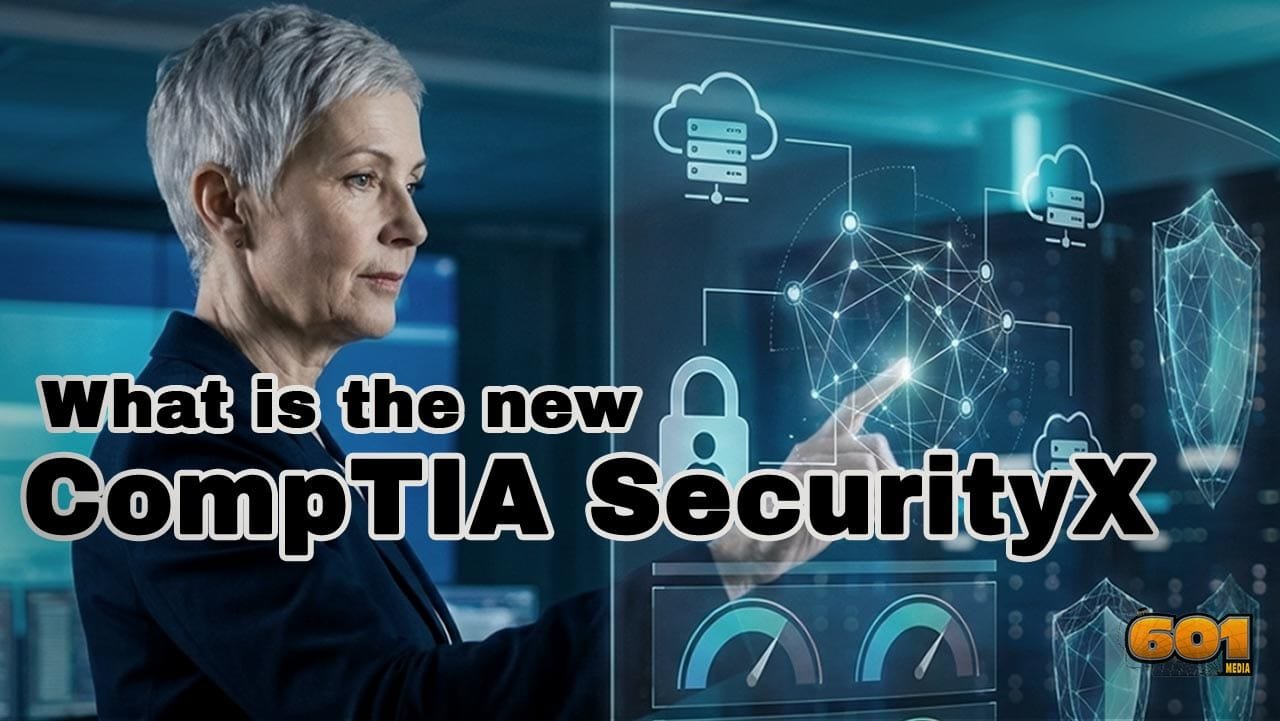
What Is the New CompTIA SecurityX?
CompTIA SecurityX is the next-generation evolution of CompTIA’s flagship cybersecurity certification, designed to validate advanced, real-world security leadership and architectural expertise. It represents a strategic shift away from purely defensive fundamentals toward enterprise-wide security design, governance, and risk-driven decision-making. SecurityX targets experienced professionals responsible for securing complex hybrid environments, aligning security with business outcomes, and leading cyber resilience initiatives at scale.
Table of Contents
- Understanding CompTIA SecurityX
- Why CompTIA Introduced SecurityX
- SecurityX vs Security+
- Skills and Domains Covered
- Who Should Earn SecurityX
- Career and Industry Impact
- Exam Structure and Difficulty
- How to Prepare for SecurityX
- The Future of SecurityX
- Top 5 Frequently Asked Questions
- Final Thoughts
- Resources
Understanding CompTIA SecurityX
CompTIA SecurityX is an advanced cybersecurity certification introduced by CompTIA to address the growing demand for security professionals who operate beyond tactical execution. Unlike entry- or mid-level certifications, SecurityX validates the ability to design, integrate, and govern security across enterprise systems, cloud-native platforms, and distributed infrastructures. SecurityX emphasizes strategic thinking, architectural oversight, and risk management rather than tool-specific configuration. It aligns with the realities of modern cybersecurity roles where leaders must balance security, usability, compliance, and cost under constant threat pressure.
Why CompTIA Introduced SecurityX
Cybersecurity has outgrown the perimeter-based defense models that shaped earlier certifications. Organizations now face ransomware-as-a-service, supply chain compromise, identity-based attacks, and regulatory scrutiny across jurisdictions. According to IBM’s annual Cost of a Data Breach report, the average breach cost continues to rise year over year, with hybrid cloud environments experiencing the highest impact.
CompTIA created SecurityX to address three critical gaps in the certification market: First, the lack of vendor-neutral certifications that validate senior-level security decision-making. Second, the growing disconnect between technical controls and business risk. Third, the need for certifications that reflect cloud-first, zero trust, and automation-driven security models. SecurityX is designed to complement—not replace—technical certifications by validating leadership-level competence.
SecurityX vs Security+
SecurityX is not a replacement for Security+. Instead, it sits several levels above it in both scope and expectation. Security+ focuses on foundational concepts such as threat types, basic cryptography, access controls, and incident response fundamentals. SecurityX assumes mastery of these concepts and builds on them with enterprise-scale application.
Key differences include: Security+ validates knowledge, while SecurityX validates judgment. Security+ asks what a control does; SecurityX asks whether that control aligns with business risk, compliance obligations, and architectural constraints. SecurityX also emphasizes cross-functional communication, security governance, and program design—areas intentionally out of scope for Security+.
Skills and Domains Covered
CompTIA SecurityX covers advanced domains that reflect real-world senior security responsibilities. Enterprise Security Architecture focuses on designing secure hybrid and multi-cloud environments, identity-centric security models, and zero trust implementation strategies. Risk Management and Governance emphasizes threat modeling, risk quantification, regulatory alignment, and security metrics that support executive decision-making. Security Operations Integration evaluates the ability to align SOC functions, incident response, automation, and threat intelligence into a cohesive operational model. Emerging Technology Risk addresses AI security, API exposure, software supply chain risk, and cloud-native attack surfaces. Business and Leadership Integration ensures candidates can translate technical risk into business impact and influence organizational strategy.
Who Should Earn SecurityX
SecurityX is designed for experienced cybersecurity professionals, not newcomers. Ideal candidates include security architects, senior security engineers, security consultants, GRC leaders, and cybersecurity managers who already operate at a strategic level. Professionals with 5–10 years of security experience benefit most, particularly those responsible for security design decisions, compliance alignment, or enterprise-wide risk management. It is also well-suited for professionals transitioning from hands-on technical roles into leadership or advisory positions.
Career and Industry Impact
SecurityX positions holders as senior, vendor-neutral security leaders. It signals to employers that the candidate understands how security functions within complex organizations—not just how tools work. Roles aligned with SecurityX include Security Architect, Lead Cybersecurity Engineer, GRC Manager, Security Program Manager, and Virtual CISO. From an industry perspective, SecurityX strengthens CompTIA’s advanced certification portfolio and provides an alternative to vendor-specific or narrowly focused expert certifications.
Exam Structure and Difficulty
The SecurityX exam is scenario-driven and analytical. Candidates are evaluated on their ability to assess complex environments, weigh competing risks, and select defensible security strategies. Questions emphasize real-world judgment rather than memorization. Expect case studies, multi-step reasoning, and architectural trade-off analysis. The difficulty level is comparable to other advanced professional certifications, with a strong focus on applied expertise rather than theoretical recall.
How to Prepare for SecurityX
Preparation for SecurityX requires more than study guides. Candidates should focus on experience-based learning. Review enterprise security architectures, zero trust frameworks, cloud shared responsibility models, and risk management methodologies such as NIST RMF and ISO 27001. Hands-on experience in cloud platforms, identity systems, and security operations significantly improves readiness. Peer discussion, architecture reviews, and scenario walkthroughs are particularly effective preparation methods.
The Future of SecurityX
SecurityX reflects a broader industry shift toward security leadership and integration. As automation reduces manual security tasks, human value increasingly lies in judgment, design, and governance. CompTIA SecurityX is positioned to remain relevant as organizations continue to modernize infrastructure and face evolving regulatory and threat landscapes. It represents a long-term investment for professionals seeking credibility at the strategic level of cybersecurity.
Top 5 Frequently Asked Questions
Final Thoughts
CompTIA SecurityX represents a meaningful evolution in cybersecurity certification. It acknowledges that modern security success depends less on individual tools and more on coherent strategy, architecture, and risk-based leadership. For experienced professionals, SecurityX offers a credible way to validate senior-level expertise in a vendor-neutral, future-focused manner.
Resources
- CompTIA Official Certification Documentation
- NIST Cybersecurity Framework
- IBM Cost of a Data Breach Report
- ISO/IEC 27001 Information Security Standard